Showing posts with label Google Home. Show all posts

Wednesday, 6 November 2019

Researchers use Lasers to hijack Google Home, Amazon Alexa and Siri


Image Source : lightcommands.com
Voice assistant devices like Google Home and Amazon Alexa have become really popular devices and are viewed as the next big thing in home automation. The open nature of these platforms and the low cost of these devices have led to a huge number of companies coming out with home automation products compatible with either one or both of them. In fact, it is really hard to find electrical appliance companies who have not forayed into this market with their latest offerings.

A team of researchers at the University of Michigan and University of Electro-Communications, Tokyo have found a surprising way to 'hijack' voice assistants with light. This is made possible by a physical phenomenon that allows light to create acoustic pressure waves. The field of research that studies this phenomenon is called photoacoustics and the first work in this field was done by none other than Alexander Graham Bell in 1880.

So, to summarize, microphones can be made to react to laser light directed at them in the same way as they react to sound. Since voice assistants use sound as the interaction medium, this phenomenon allows them to be made to do so by light as well. The most scary part of this is that light waves are inaudible and so people will not be able to detect that a command is being sent to their device.

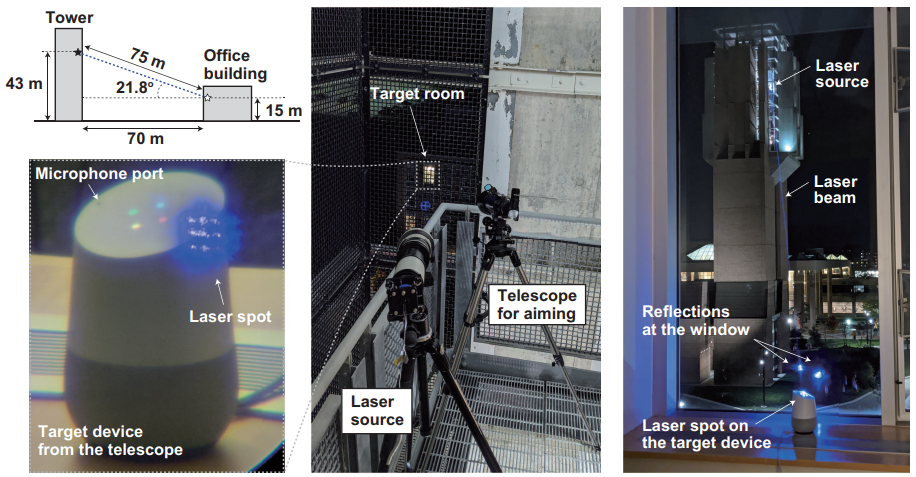
At the start of this article you can see a diagram illustrating how a laser directed from 75 meters away at a downward angle of 21 degrees and through a glass window was able to make a Google Home open the garage door. Below is a video of the same demonstration:


Now, many of you might be thinking that these devices do have voice recognition and that should be enough to protect your devices from following commands that are not your own. However, it seems that this feature is enabled by default only on smartphones and tablets and not on smart speakers. In addition, only the wake-up commands like "OK Google" and "Alexa" are verified by the devices and not the rest of the commands. To compound this problems it has been found that the verification is quite weak and can be fooled by online text to speech synthesis tools that can imitate people's voice. We have also seen demonstrations of technologies using machine learning to imitate people's voices to a high degree of accuracy.

The researchers were able to send commands to Siri one devices like the iPhone XR and iPad 6th Gen as well, so Apple devices are vulnerable to these hijackings as well.

Two drawbacks for hijackers and advantages for us are that this technology only works in Line of sight and there is no way to for the hijacking system to get the feedback about successful execution of commands from the device unless they are in the audible range of the device's speaker. Nevertheless, until companies come up with really secure counter measures, be wary of connecting devices that could compromise your security if hijacked.

Sunday, 22 July 2018

Fuchsia OS from Google - The Android Killer?

Image Source : www.howtogeek.com
Android has become an inseparable part of the lives of the people who are altogether using over 2 billion Android devices around the world among which are three quarters of the world's smartphones. It has spread like wildfire since its first use in a commercial device back in September 2008. However since Android came into existence with the rise of touchscreen phones, it wasn't really designed for voice interactions powered by Machine Learning and AI capabilities that Google envisions for the future.

A team of Google engineers have thus been secretly working on an open source Operating System called Fuchsia with voice interaction capabilities at its core, that they hope will replace Android as the world's dominant mobile Operating System.The current strength of this secretive team stands at 100 including talented people like Matias Duarte, Vice President of Material Design at Google. 

Image Source : thumbs.dreamstime.com

Fuchsia uses a kernel called Zircon and this move away from Linux allows the developers to build from scratch a more optimized OS with better security and is easier to upgrade. The ability to start from scratch has allowed the developers to incorporate many changes which they felt necessary learning from their mistakes with Android. One such example being Google being dependent on device manufacturers to roll out the latest software updates which the manufactures don't have much incentive to do.

Fuchsia aims at being the single Operating System which is capable of running all of Google's Products like Pixel phones and smart speakers as well as third party devices which currently run on Android OS or Chrome OS.

Image Source : cnet

The first target of Fuchsia is to be embedded in all smart speakers like the Google Home speakers in the next three years and then move on to larger devices like Laptops. In the next five years they aim to replace Android in all smartphones.Fuchsia is being developed with adaptation to multiple screen sizes in mind making it suitable for use across all device types.

Android currently supports a huge number of hardware devices, developers and advertisement agencies and so it is going to be anything but easy to replace it. Also, there is no publicly announced roadmap from Google with regards to Fuchsia. Added to this are some reportedly fierce internal debates with respect to tighter privacy principles inherent in fuchsia which could affect Google's ad revenue as they depend heavily on user data to deploy targeted ads.

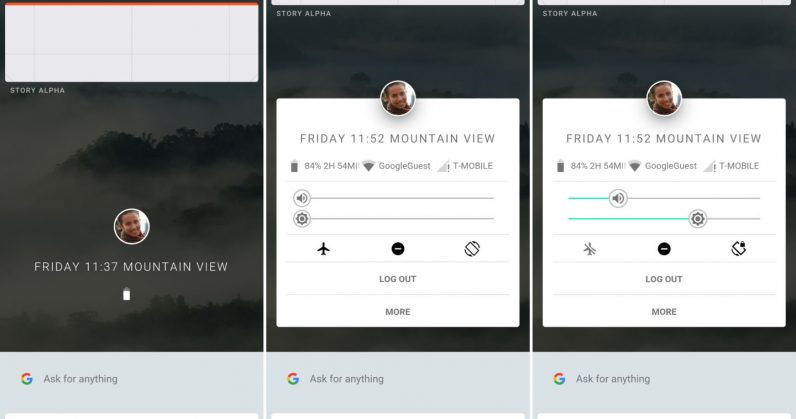
Fuchsia OS Preview | Image Source : cdn0.tnwcdn.com

Even though it seems that a lot is stacked up against Fuchsia OS, history clearly say that nothing can stop a technology when its time has come. The push by Google in its last keynote to voice interactions, the increasing entry into smart home devices by many major companies coupled with the problems of Android with respect to performance, security and rolling out of updates clearly indicates that the time for Fuchsia has come.


How soon do you think Fuchsia OS will become prevalent?
Do leave you comments and reactions below.